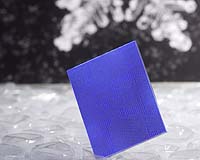
A technique for controlling the magnetic properties of a commonly used blue dye could revolutionise computer processing power, according to research published recently in Advanced Materials. Scientists have demonstrated that they can control the properties in a dye known as Metal Phthalocyanine, or MPc, with the use of magnetism.
Though this technology is still in its infancy, researchers claim that the ability to control the magnetic properties of MPc could have the potential to dramatically improve information processing in the future. iPods, CD read/writers, and other electronic devices already use magnetism as a system for signalling to process and store information.
Current technology, however, has limitations. According to Moore's Law – a theory for describing the historical trend of computer hardware development – computer technology will eventually reach a 'dead end' as options for shrinking the size and increasing memory run out.
Dr Sandrine Heutz, from Imperial College London's Department of Materials, and scientists from the London Centre for Nanotechnology, believe results from recent experiments with MPc could provide the answer.
MPc contains carbon, nitrogen and hydrogen and can also contain a wide range of atoms at its centre. In their work they used either a copper or manganese metal atom at its centre. Scientists first observed MPc in 1907 and it has been used ever since as a dye in textiles and paper and has even been investigated for use as an anti-cancer agent.
Dr Heutz made a scientific breakthrough when she experimented with clusters of MPc. She found that she could make the metal centres of MPc have tiny magnetic interactions with one another. Like placing two compasses together and controlling which way the arrows point, she found that she could control how the metal centres of MPc spin in relation to one another.
The secret to controlling this spin lies in the way Dr Heutz experimented with MPc. She grew stacks of MPc in crystal structures on plastic surfaces and then experimented with the preparation conditions. She grew them at room temperature; applied heat; chemically altered the plastic surfaces that the crystals grew on; and changed the way the crystals grew. All these different elements altered the way the metal centres interacted with each other.
After three years of experimentation, the team can now control a set of microscopic interactions between the molecules.
Current information processing uses a switching process of zeros and ones to process and store 'bits' of information. Dr Heutz believes she could improve on this process to increase memory. So far the team can switch the interactions from 'on/off' and change the state of the interaction from 'on' to a different type of 'on'. They are still experimenting with ways to turn the interaction 'off/on'. When they find this last interaction Dr Heutz believes she will have a superior set of molecular signals for information processing and storage.
"Electronic devices already use magnetism as a system for processing and storing information. These experiments prove that we will be able to replace the current electro-magnetic process with a magnetic interaction between molecules of MPc," said Dr Heutz.
Dr Heutz says it could take a further five years to practically apply this technology. When the refinements are complete she believes exploiting MPc molecules will have enormous benefits in the development of 'spintronics' – a process which relies on the spin of atoms or molecules to store trillions of bits of information per square inch.
She also believes these molecular interactions have the potential to process 'qubits' of information in quantum computing. According to current theories, quantum computing is expected to harness the properties of quantum mechanics to perform tasks that classical computers cannot do in a reasonable time.
"We are still a long way off from applying this technology to the home PC. However, in five years time our experiments will demonstrate that we will have the power to unleash the vast potential of information processing at the molecular level," she said.