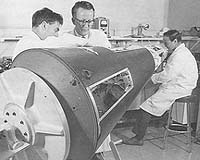
The satellite itself weighed 45 kilograms and was 1.59 metres long. It was built at the WRE, with the development of the satellite's experimental instrumentation and some of the satellite's testing being conducted at the University of Adelaide.
The satellite itself weighed 45 kilograms and was 1.59 metres long. It was built at the WRE, with the development of the satellite's experimental instrumentation and some of the satellite's testing being conducted at the University of Adelaide. |
The Wresat project was led by Bryan Rofe from the WRE and Professor John Henry Carver, who was Elder Professor and Head of Physics at the University of Adelaide at the time.
The current Head of the School of Chemistry and Physics at the University of Adelaide, Professor John Adrian Carver, is the son of the late Professor John Henry Carver. Professor Carver was nine years old when his father helped to launch Wresat into space.
"It was an incredible feat of organisation," Professor Carver says.
"The satellite was launched using a modified Redstone rocket donated by the Americans, but there was only an 11-month window for the Australian team to use the rocket before the Americans had to leave.
"This gave the WRE/University team 11 months to plan, design, build, test and execute the launch of the satellite. They managed to achieve it, and it was a huge success for Australia at that time, with much associated publicity in the media."
The satellite itself weighed 45 kilograms and was 1.59 metres long. It was built at the WRE, with the development of the satellite's experimental instrumentation and some of the satellite's testing being conducted at the University of Adelaide.
The battery-operated satellite was used to collect data about the composition of the upper atmosphere. It had enough power to send data during its first 73 orbits around the Earth.
It re-entered the atmosphere on 10 January 1968, over the Atlantic. Nothing of it remains.
"The successful launch of Wresat meant that Australia became the 4th country to launch its own satellite into space from its own territory, which is a significant achievement in itself, and a landmark in Australian science," Professor Carver says.
Related Links
 ESA And Inmarsat Sign Innovative Alphasat Satellite Contract
 Paris, France (ESA) Nov 26, 2007
| The content herein, unless otherwise known to be public domain, are Copyright Space.TV Corporation. AFP and UPI Wire Stories are copyright Agence France-Presse and United Press International. ESA Portal Reports are copyright European Space Agency. All NASA sourced material is public domain. Additional copyrights may apply in whole or part to other bona fide parties. Advertising does not imply endorsement, agreement or approval of any opinions, statements or information provided by Space.TV Corp on any Web page published or hosted by Space.TV Corp. Privacy Statement |