 |
 |
 |
 |
 |
 |
 |
 |
 |

 |
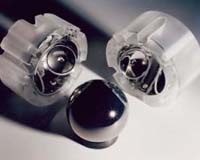
Northrop Grumman Resonating Gyro Achieves 10 Million Operating Hours In Space
Woodland Hills CA (SPX) May 20, 2008 Northrop Grumman's patented hemispherical resonating gyro (HRG) technology recently surpassed 10 million hours of continuous service in support of myriad commercial and military space applications dating back to February of 1996. The gyros are critical components of inertial navigation systems that enable the stabilization, tracking and attitude control of satellites and spacecraft. "Northrop Grumman's HRG is a high accuracy, extremely reliable gyro that has experienced no mission failures. It combines high performance with the longest life of any inertial technology now in space," said Gorik Hossepian, vice president of Navigation and Positioning Systems for Northrop Grumman's Navigation Systems Division. "It has no moving parts and its simple design, small size, low noise output and high radiation tolerance make it an ideal gyro for extended space missions." Installed in Northrop Grumman's space qualified inertial reference systems, the HRG with its thin-walled quartz shell sensing element has been used in over 90 space missions. Applications include commercial, military and civil/scientific programs for domestic and international customers. Based on scientific observations over 200 years ago on a "ringing" wineglass, this technology was first used on the Near Earth Asteroid Rendezvous mission, the first of NASA's Discovery missions and the first mission ever to place a spacecraft into orbit around an asteroid. The newest product employing HRG technology is Northrop Grumman's scalable space inertial reference unit (Scalable SIRU). The Scalable SIRU was instrumental in achieving the scientific objectives of the highly successful MESSENGER and Deep Impact program missions. The Scalable SIRU and its predecessor, the space inertial reference unit (SIRU), supply critical angular rate and linear acceleration data for use in satellites and spacecraft for stabilization, tracking and attitude control. Northrop Grumman has experience in development and support of all current production gyro technologies. Besides its exclusive hemispheric resonator gyro, it produces spinning mass gyros, ring laser gyros, its unique ZLG gyros, fiber-optic gyros and micro-electro-mechanical-system gyros. Related Links Space Technology News - Applications and Research
 TerraSAR-X And NFIRE Fire Up The Pipe With Laser Data Transfer
 Bonn, Germany (SPX) May 14, 2008
Satellites currently use radio waves to exchange data. Now the data rate has been increased a hundredfold by using lasers instead of radio signals. Two test satellites each carried a diode laser pump module developed with the help of Fraunhofer researchers. |
|
|

| The content herein, unless otherwise known to be public domain, are Copyright Space.TV Corporation. AFP and UPI Wire Stories are copyright Agence France-Presse and United Press International. ESA Portal Reports are copyright European Space Agency. All NASA sourced material is public domain. Additional copyrights may apply in whole or part to other bona fide parties. Advertising does not imply endorsement, agreement or approval of any opinions, statements or information provided by Space.TV Corp on any Web page published or hosted by Space.TV Corp. Privacy Statement |