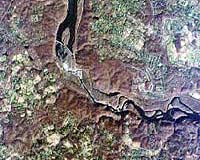
The data collected by Hyperion and the science team results will also be invaluable in future measurements and monitoring of the global carbon content, a critical element of global warming concerns.
The data collected by Hyperion and the science team results will also be invaluable in future measurements and monitoring of the global carbon content, a critical element of global warming concerns. |
Hyperion has produced more than 35,000 images in the last seven years that have been used by science teams, commercial users and military users around the country. Hyperion has proven the value of space-based hyperspectral data for use in global land-cover studies, ecosystem monitoring, mineral and petroleum prospecting and agricultural crop discrimination and assessment, among other important applications.
"Hyperion demonstrates the technological excellence and outstanding reliability that's a hallmark of our systems, spacecraft and sensors," said David L. Ryan, vice president and general manager of Civil Systems Division for Northrop Grumman's Space Technology sector. "Built as a rapid response program with a short turnaround from design to delivery, Hyperion has proven to be an extremely robust sensor."
The data collected by Hyperion and the science team results will also be invaluable in future measurements and monitoring of the global carbon content, a critical element of global warming concerns.
"Hyperion has shown that hyperspectral data can be used effectively to monitor vegetation biomass, atmospheric carbon content, and carbon uptake of the oceans," said Mark Folkman, director of Civil Sensor Systems for Northrop Grumman Space Technology. "We are currently developing an affordable follow-on to take improved hyperspectral images with partners NASA Ames Research Center and several universities through NASA's Innovative Partners Program."
Hyperion is one of three science instruments aboard EO-1 and is designed to view the Earth in 220 spectral bands ranging from the visible through short wave infrared.
Originally intended to be on-orbit for one year, Hyperion completed its mission as part of NASA's New Millennium Program and has been in an extended mission since. The New Millennium Program was created to demonstrate advanced technologies and designs that show promise for dramatically reducing the cost and improving the quality of instruments and spacecraft for future missions.
Related Links
 Rosetta: Earth's True Colours
 Paris, France (SPX) Nov 22, 2007
| The content herein, unless otherwise known to be public domain, are Copyright Space.TV Corporation. AFP and UPI Wire Stories are copyright Agence France-Presse and United Press International. ESA Portal Reports are copyright European Space Agency. All NASA sourced material is public domain. Additional copyrights may apply in whole or part to other bona fide parties. Advertising does not imply endorsement, agreement or approval of any opinions, statements or information provided by Space.TV Corp on any Web page published or hosted by Space.TV Corp. Privacy Statement |