 |
 |
 |
 |
 |
 |
 |
 |
 |

 |
From Shampoo Aroma To Ice Cream Texture
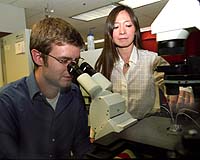
St. Louis MO (SPX) Jan 03, 2007 Researchers at Washington University in St. Louis are putting a different kind of "foursome" together in hopes of someday developing smart materials called biomimetics that mimic nature. Amy Shen, Ph.D., assistant professor of mechanical and aerospace engineering, and her Washington University colleague William F. Pickard, Ph.D., senior professor of electrical and systems engineering, are collaborating with Michael Knoblauch, Ph.D., of Washington State University, and Winfried S. Peters, Ph.D., of Indiana University/Purdue University in Fort Wayne, on understanding a novel plant protein structure called forisome. Shen and Pickard are probing the biomechanical properties of the forisome, which, in a variety of plants, responds to injury by swelling up in reaction to an increase of calcium. The swelling of the proteins within transport cells protects the plant from hemorrhaging nutrients. Once the danger passes, the forisomes go back to their original shapes. The foursome's goal is to understand the system well enough to enable future collaborators to develop a chemically stable artificial forisome -- a non-living system that can integrate functions such as sensing, acting and logic in response to external stimuli. Such a smart material would be biomimetic. One of the best examples of a natural system that exhibits the behavior that researchers would like to synthesize -- a biomimetic -- is the famed Venus flytrap. Forisome is particularly attractive as a biomimetic smart material because, unlike most protein motors, it is not dependent on adenosine triphosphate (ATP) for its activation, making it more flexible. Shen used a microfluidic device - a soft lithography system of micro-channels embedded in fluids, so small it fits in the palm of a hand - to see how the forisome proteins would react to changes in calcium, pH and the hydrodynamic environment itself.
Swell protein Shen and her collaborators found that they could induce swelling easily as well as reverse the swelling in the device, rather more easily than other systems used previously to study the proteins. "We're interested in the kinetics of the forisome proteins," Shen said. "We wanted to see how fast they change shape and also their potential as a smart material. We intend to do other experiments that might reveal the durability and actuation kinetics of forisomes." Shen and her colleagues published their results in the July 2006 issue of Smart Structures and Systems, An International Journal, Vol. 2, Number 3, 225-236. A separate paper also was published on the prospective energy densities on forisome in 2006 in Materials Science and Engineering: C Biomimetic and Supramolecular Systems, 26 (1), 104-112, 2006. Shen designs microfluidic devices to study a wide variety of complex fluids and how they behave hydrodynamically on a very small scale, anything" hard to see with the naked eye," she says. "The devices are useful for lots of applications, for making novel materials, drug delivery, and for studying the cellular and neuronal growth. We're able to observe interfacial phenomena under a microscope." Collaborations Shen has performed research for Procter and Gamble, for instance, to determine shelf life of shampoos and hair conditioners. If the company wants to blend a certain type of shampoo with a perfume, she can study the stability of the mixture inside a microfluidic device under the microscope instantaneously. Shen is also collaborating with Lars Angenent, Ph.D., Washington University assistant professor of chemical engineering, on the behavior of methanogens inside a microfluidic device, by imposing a concentration gradient to see what's the optimal pH level methanogens prefer to grow. Their study can be applied in making microbial fuel cells and biofuel cells. Shen also is working with medical doctors in the Washington University School of Medicine to see how cells and neurons behave by guided channel design in the microfluidic environment. She also is making monodispersed liquid crystal droplets- which are the basis of computer and TV screens -- and polymer solutions (R. Sureshkumar, Ph.D., Washington University professor of chemical engineering) inside the microchannels. "In general, microfluidic devices are pretty powerful," Shen said. "You can study anything from tiny droplets to mixing of multiple fluids. What would take months or years for macroscopic systems can be done within seconds or minutes with microfluidic devices. We often find in these environments that surface properties and geometric confinement in liquid-liquid or liquid- gas systems behave much differently than they do in beakers or tanks. " And that's very important in fabricating new materials for high tech applications, making sleek shampoos, drug delivery systems, or just improving the ice cream or ketchup texture. Related Links Washington University in St. Louis Shen Web site All about the technology of space and more Space Technology News - Applications and Research
 The Mathematics Of Cloaking
 Rochester NY (SPX) Jan 01, 2007
The theorists who first created the mathematics that describe the behavior of the recently announced "invisibility cloak" have revealed a new analysis that may extend the current cloak's powers, enabling it to hide even actively radiating objects like a flashlight or cell phone. |
|
|

| The content herein, unless otherwise known to be public domain, are Copyright Space.TV Corporation. AFP and UPI Wire Stories are copyright Agence France-Presse and United Press International. ESA Portal Reports are copyright European Space Agency. All NASA sourced material is public domain. Additional copyrights may apply in whole or part to other bona fide parties. Advertising does not imply endorsement, agreement or approval of any opinions, statements or information provided by Space.TV Corp on any Web page published or hosted by Space.TV Corp. Privacy Statement |