 |
 |
 |
 |
 |
 |
 |
 |
 |

 |
Two-Faced Miniatures
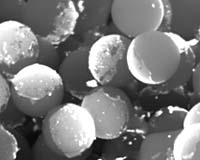
Cambridge MA (SPX) Nov 20, 2007 Many scientists are working feverishly to develop reliable but simple methods for the production of tiny particles with defined size and shape that are covered with special regular patterns in two or three dimensions and at both the nano- and the microscale. These miniature objects have countless applications in modern technology, from diagnostic systems to the generation of artificial tissues to improved data storage. A team headed by Edwin L. Thomas and Patrick S. Doyle at MIT in Cambridge, Massachusetts (USA) has now developed a new method for the large-scale synthesis of three-dimensionally patterned polymer particles with morphological characteristics in the submicrometer range. As described in the journal Angewandte Chemie, with the use of stop-flow interference lithography, the team has even been able to produce Janus particles, microparticles with two chemically different hemispheres. "Our new method is a combination of phase mask interference lithography and mirofluidic flow lithography, unifying the strengths of these two methods," explain the researchers. Liquid precursors of a polymer whose formation is induced by light are introduced into a microfluidic system (a system of channels that are just a few micrometers wide). The bottom portion of the device is a phase mask with a periodic surface structure. This arrangement is irradiated through a transparency mask that defines the shape of the resulting particles. In a test sample these were triangles with sides of 60 micrometres. Once the parallel light rays pass through the strictly periodic surface structure of the phase mask, the result is a complex three-dimensional distribution of light intensity within the liquid (interference). In regions of high intensity, the polymer precursors are cross-linked to form three-dimensional structures in a solid hydrogel. In this way, the researchers were able to give the triangular particles a knobby, lattice-like structure. Because this method works continuously, it can attain a very high throughput: Liquid flows in and polymerizes to form particles that are immediately rinsed away when the next portion of liquid follows-all in less than a second. In contrast to other techniques, the liquid does not need to be deposited in an even layer on a support and developed stepwise. In addition, within a microchannel, it is possible to allow two different liquids to flow side by side without mixing. If the transparency mask is adjusted so that the light irradiates a region around the boundary between the two liquids, the process results in Janus particles with two chemically different hemispheres. Related Links Computer Chip Architecture, Technology and Manufacture Nano Technology News From SpaceMart.com
 "Trapped rainbow" could herald new dawn for computing
 Paris (AFP) Nov 14, 2007
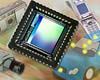
Scientists in Britain said Wednesday they were able to slow and then stop a squirt of light in what they described as a key step towards the future of ultra-fast computing. |
|
|

| The content herein, unless otherwise known to be public domain, are Copyright Space.TV Corporation. AFP and UPI Wire Stories are copyright Agence France-Presse and United Press International. ESA Portal Reports are copyright European Space Agency. All NASA sourced material is public domain. Additional copyrights may apply in whole or part to other bona fide parties. Advertising does not imply endorsement, agreement or approval of any opinions, statements or information provided by Space.TV Corp on any Web page published or hosted by Space.TV Corp. Privacy Statement |