 |
 |
 |
 |
 |
 |
 |
 |
 |

 |
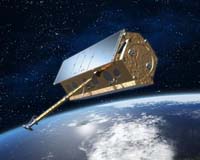
TerraSAR-X And NFIRE Fire Up The Pipe With Laser Data Transfer
Bonn, Germany (SPX) May 14, 2008 Satellites currently use radio waves to exchange data. Now the data rate has been increased a hundredfold by using lasers instead of radio signals. Two test satellites each carried a diode laser pump module developed with the help of Fraunhofer researchers. The data whizzed back and forth at the speed of light between German satellite TerraSAR-X and US satellite NFIRE, covering more than 5000 kilometers in space without any errors. What was special about this space test recently performed by Tesat-Spacecom was that the data was transmitted by laser. The bandwidth achieved in the test was a hundred times greater than during conventional communication by radio waves, enabling a data rate equivalent to roughly 400 DVDs per hour. This could make it possible to transmit large data packets between several satellites in the future, for instance to send image data from Earth observation satellites to a ground station. That has not been possible until now, as the bandwidth of radio waves is not large enough. Another advantage of this new form of communication is that lasers are easier to focus than radio waves, which means that data transmissions can be directed more accurately. The communication lasers on board the satellite are actuated by pump modules, which were developed to a large extent by researchers at the Fraunhofer Institute for Laser Technology ILT in Aachen on behalf of Tesat GmbH and Co. KG as part of a program financed by the German Aerospace Center (DLR). "The modules have to withstand the vibrations and forces of acceleration on board the satellites during the launch and must then survive the inhospitable conditions in space - such as extreme radiation and strong temperature differences," says Martin Traub, who led the developments at the ILT. "We therefore tested the pump modules under extreme conditions in advance, subjecting them to temperatures of -35degreesC to 60degreesC, acceleration forces 1300 times as strong as those of the Earth, and gamma rays." The modules mustn't be too big or too heavy for use in space: Measuring 5 x 5 x 2 centimeters, they are barely larger than a matchbox, and weigh little more than a bar of chocolate at 130 grams. "We achieved this minimal weight by selecting the right materials and a sophisticated housing: Any material that wasn't absolutely essential was milled away," says Traub. The major challenge is that, despite the reduced weight, the heat generated by the laser's several-watt output still has to be dissipated. Related Links Fraunhofer-Gesellschaft Space Technology News - Applications and Research
 Raytheon Reaches Key Milestone On NASA Glory Space Program
 El Segundo CA (SPX) May 13, 2008
Raytheon has completed manufacture and testing of the optics detector module for the aerosol polarimetry sensor. The sensor will ride on the NASA Glory satellite to help agency and other federal officials better understand the impact of aerosols on global warming and climate change. |
|
|

| The content herein, unless otherwise known to be public domain, are Copyright Space.TV Corporation. AFP and UPI Wire Stories are copyright Agence France-Presse and United Press International. ESA Portal Reports are copyright European Space Agency. All NASA sourced material is public domain. Additional copyrights may apply in whole or part to other bona fide parties. Advertising does not imply endorsement, agreement or approval of any opinions, statements or information provided by Space.TV Corp on any Web page published or hosted by Space.TV Corp. Privacy Statement |