 |
 |
 |
 |
 |
 |
 |
 |
 |

 |
TDRS Satellites Set New Standard For Long Life And Reliability
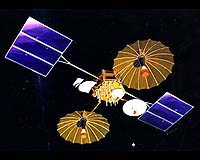
Redondo Beach CA (SPX) Apr 11, 2007 Six Northrop Grumman communication satellites in the Tracking and Data Relay Satellite System (TDRSS) have set a new standard for long life and reliability, enhancing earth-to-space communications for nearly a quarter of a century. Expected to collectively provide service for somewhere between 42 to 60 years, the constellation is approaching 102 years of operation without a single satellite being retired from service, based on the 10-year planned life of each satellite. Pioneered by the company's Space Technology sector, the six TDRSS satellites number among the 26 successful geosynchronous spacecraft built by Northrop Grumman in the last 25 years, all of which are still operating. "TDRSS is an outstanding example of the excellent, long-standing partnership between Northrop Grumman and NASA, which has moved science and technology forward to support the nation," said Alexis Livanos, corporate vice president and president of Northrop Grumman's Space Technology sector. "The longevity and reliability of TDRSS has provided high performance and exceptional value to NASA and other users." The oldest satellite in the TDRS system has been in operation for nearly 24 years. It is still supporting missions, including one that was never envisioned for TDRSS. The satellite relays wideband data from National Science Foundation researchers at the South Pole to their headquarters in the United States. Against all odds, the satellite dramatically survived a nearly catastrophic launch vehicle failure that required several months of thrusting with one-pound thrust attitude control motors to reach the correct orbit. When it was launched in 1983, TDRS Flight 1 was the largest and most sophisticated communications satellite ever built. A communication signal relay system, TDRSS transmits voice, television, and digital and analog data between users' satellites and control centers on Earth. The system is capable of transmitting and receiving data from customer satellites over their entire orbit, greatly enhancing the productivity of space assets. In total, the six Northrop Grumman-built TDRSS spacecraft have logged more than 37,000 mission days on orbit, delivering more than 800,000 hours of service. In 2004, Northrop Grumman and NASA's Goddard Space Flight Center received the prestigious National Space Club's Nelson P. Jackson Aerospace Award for the TDRSS program. The award is presented annually to recognize exceptional teamwork between government and industry in the missile, aircraft and space fields. The 2004 award marked the seventh time Northrop Grumman Space Technology has won and/or shared the Jackson Aerospace Award. Related Links Northrop Grumman The latest information about the Commercial Satellite Industry Space Technology News - Applications and Research
 United Space Alliance Brings New Innovations to Future Space Operations
 Colorado Springs CO (SPX) Apr 10, 2007
Transitioning essential knowledge and experience from the Space Shuttle and the International Space Station to the Constellation Program will be one of the keys to the efficiency, reliability, safety and overall success of the new program. At last year's National Space Symposium, United Space Alliance (USA) introduced its revolutionary Questus software suite as the first-ever set of integrated applications and tools specifically created to capture and transition that knowledge and experience in space operations. |
|
|

| The content herein, unless otherwise known to be public domain, are Copyright Space.TV Corporation. AFP and UPI Wire Stories are copyright Agence France-Presse and United Press International. ESA Portal Reports are copyright European Space Agency. All NASA sourced material is public domain. Additional copyrights may apply in whole or part to other bona fide parties. Advertising does not imply endorsement, agreement or approval of any opinions, statements or information provided by Space.TV Corp on any Web page published or hosted by Space.TV Corp. Privacy Statement |