
SPACE MART SPACE DAILY SPACE WAR TERRA DAILY MARS DAILY SPACE TRAVEL GPS DAILY ENERGY DAILY
  Space Industry and Business News  
Get Our Free Newsletters Via Email
  
Search All Our Sites at SpaceBank
Stroll virtual world without moving a finger

by Staff Writers
Tokyo (AFP) Oct 12, 2007
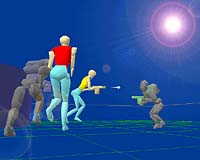
Japanese researchers say they have found a way to let people stroll through the virtual world of Second Life using their own imagination, in a development that could help paralysis patients.

Previous studies have shown people can move computer cursors through brain waves, but the Japanese team says it is the first to apply the technology to an Internet virtual world.

The technology "would enable people suffering paralysis to communicate with others or do business through chatting and shopping in a virtual world," said Junichi Ushiba, associate professor at Keio Univesity's rehabilitation centre.

Second Life is an increasingly popular virtual world in which people -- and animals -- are represented by animated avatars and can do everything from social activities to shopping.

Ushiba said Second Life could motivate patients with severe paralysis, who are often too depressed to undergo rehabilitation.

"If they can see with their own eyes their characters moving around, it could reinvigorate their brain activity and restore some functions," he said.

Under the technology, a person wearing head gear embedded with electrodes, which analyse brain waves in the cerebral motor cortex, would be able to move a Second Life character forward by thinking he or she is walking.

Imagining movement with the right or left hand would make the character turn accordingly in the same direction.

Researchers have previously put similar technology to work to scan brain waves to control objects such as computer cursors and electrical gears.

In the Keio University laboratory, the team has designed artificial arms that operate by reading brain waves, although none is known to be commercially available yet.

Ushiba said the technology could help people undergoing neuro-rehabilitation by stimulating brain activity.

Traditionally, "if a stroke leaves a man's right hand paralysed, he has been encouraged to use his left hand instead," Ushiba said.

"More recently, however, it has come to light that the paralysed hand would start moving better if you try to use it," Ushiba said, noting that attempts to use a numb hand increase brain activity.

The team next plans to test the technology on actual paralysis patients to see how they respond to the virtual world.

Community
Email This Article
Comment On This Article

Related Links
Space Technology News - Applications and Research


Speeding Up CT Scans By Using Telecommunications Tricks
College Park MD (SPX) Jul 18, 2007
By borrowing techniques used in telecommunications technology, computed tomography (CT) scanners may eventually see data collection speeds increase by hundreds of times, leading to better images, faster imaging procedures, and potentially lower x-ray exposures. A University of North Carolina team has pioneered a method that collects images from many sources at once, instead of the current serial method of data collection.


Memory Foam Mattress Review

Newsletters :: SpaceDaily Express :: SpaceWar Express :: TerraDaily Express :: Energy Daily
XML Feeds :: Space News :: Earth News :: War News :: Solar Energy News
  • US cities' Wi-Fi dreams fading fast
  • Digital Dandelions: The Flowering Of Network Research
  • Researchers Aim To Make Internet Bandwidth A Global Currency
  • Controlling Bandwidth In The Clouds

  • Boeing Ships Third Thuraya Communications Satellite To Sea Launch Home Port
  • Proton Rocket To Launch Three Glonass Satellites Oct 25
  • SSTL Satellites Sign-Up For 2008 Launch
  • Ariane 5 rocket puts US, Australian satellites into orbit

  • MEPs seek limits on aircraft emissions by 2010
  • New Delft Material Concept For Aircraft Wings Could Save Billions
  • Aircraft And Automobiles Thrive In Hurricane-Force Winds At Lockheed Martin
  • Cathay Pacific chief hits out at anti-aviation critics

  • USAF Launches First Of Next Gen Communications Satellites
  • Australia To Join With United States In Defence Global Satellite Communications Capability
  • First Class Of Airmen Train For Wideband Global SATCOM
  • Australia To Join With United States In Defence Global Satellite Communications Capability

  • Stroll virtual world without moving a finger
  • Small is beautiful: Incredible shrinking memory drives new IT
  • Northrop Grumman Tests Multi-Mission Command And Telemetry System For Key Global Space Programs
  • New Transparent Plastic Strong As Steel

  • MBDA Director Takes Up Business Management Assignment On The MEADS Program
  • Analysis: Sulick new head spy for CIA
  • Raytheon Names Dr. Thomas Kennedy VP Tactical Airborne Systems
  • Northrop Grumman Appoints James Myers VP And GM Of Navigation Systems Division

  • Successful Image Taking By The High Definition Television
  • Boeing Launches WorldView-1 Earth-Imaging Satellite
  • New Faraway Sensors Warn Of Emerging Hurricane's Strength
  • Key Sensor For Northrop Grumman NPOESS Program Passes Critical Structural Test

  • Hynix Semiconductor Develops Industry's Smallest 1Gb Mobile DRAM
  • Polar Launches Multisport Training System
  • ClearPoint Rolls Out High Resolution Sailing Hot Spots For Olympic And Global Sailing Centers
  • Broward County Sheriff's Office Awards BI Incorporated Large GPS Tracking Contract

  • The content herein, unless otherwise known to be public domain, are Copyright 1995-2006 - SpaceDaily.AFP and UPI Wire Stories are copyright Agence France-Presse and United Press International. ESA PortalReports are copyright European Space Agency. All NASA sourced material is public domain. Additionalcopyrights may apply in whole or part to other bona fide parties. Advertising does not imply endorsement,agreement or approval of any opinions, statements or information provided by SpaceDaily on any Web page published or hosted by SpaceDaily. Privacy Statement