 |
 |
 |
 |
 |
 |
 |
 |
 |

 |
Silicon Nanowires Upgrade Data-Storage Technology
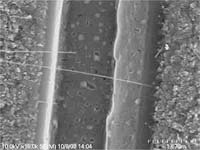
Washington DC (SPX) Jun 11, 2007 Scientists at the National Institute of Standards and Technology (NIST), along with colleagues at George Mason University and Kwangwoon University in Korea, have fabricated a memory device that combines silicon nanowires with a more traditional type of data-storage. Their hybrid structure may be more reliable than other nanowire-based memory devices recently built and more easily integrated into commercial applications. As reported in a recent paper, the device is a type of "non-volatile" memory, meaning stored information is not lost when the device is without power. So-called "flash" memory (used in digital camera memory cards, USB memory sticks, etc.) is a well-known example of electronic non-volatile memory. In this new device, nanowires are integrated with a higher-end type of non-volatile memory that is similar to flash, a layered structure known as semiconductor-oxide-nitride-oxide-semiconductor (SONOS) technology. The nanowires are positioned using a hands-off self-alignment technique, which could allow the production cost-and therefore the overall cost-of large-scale viable devices to be lower than flash memory cards, which require more complicated fabrication methods. The researchers grew the nanowires onto a layered oxide-nitride-oxide substrate. Applying a positive voltage across the wires causes electrons in the wires to tunnel down into the substrate, charging it. A negative voltage causes the electrons to tunnel back up into the wires. This process is the key to the device's memory function: when fully charged, each nanowire device stores a single bit of information, either a "0" or a "1" depending on the position of the electrons. When no voltage is present, the stored information can be read. The device combines the excellent electronic properties of nanowires with established technology, and thus has several characteristics that make it very promising for applications in non-volatile memory. For example, it has simple read, write, and erase capabilities. It boasts a large memory window-the voltage range over which it stores information-which indicates good memory retention and a high resistance to disturbances from outside voltages. The device also has a large on/off current ratio, a property that allows the circuit to clearly distinguish between the "0" and "1" states. Two advantages the NIST design may hold over alternative proposals for nanowire-based memory devices, the researchers say, are better stability at higher temperatures and easier integration into existing chip fabrication technology. Related Links National Institute of Standards and Technology (NIST) Nano Technology News From SpaceMart.com Computer Chip Architecture, Technology and Manufacture
 Russia To Redirect Billions In Major Nanotechnology Push
 Moscow (AFP) Jun 06, 2007
Russia is budgeting billions of dollars to spend on nanotechnologies in a bid to catch up with the West, but development of the sector is still held back by a wary business community, experts say. Lawmakers on Monday put forward a draft law to create Rosnanotekh, a state nanotechnology corporation with a budget of five billion dollars (3.7 billion euros) that will inject funds into Russia's long-neglected science establishment. |
|
|

| The content herein, unless otherwise known to be public domain, are Copyright Space.TV Corporation. AFP and UPI Wire Stories are copyright Agence France-Presse and United Press International. ESA Portal Reports are copyright European Space Agency. All NASA sourced material is public domain. Additional copyrights may apply in whole or part to other bona fide parties. Advertising does not imply endorsement, agreement or approval of any opinions, statements or information provided by Space.TV Corp on any Web page published or hosted by Space.TV Corp. Privacy Statement |