Satellites taking atmospheric measurements might now be able to see blue skies as clearly as optimists do. Researchers have found a way to reduce cloud-induced glare when satellites measure blue skies on cloudy days, by as much as ten-fold in some cases.
The result might lead to more accurate estimates of the amount of sunlight penetrating the atmosphere. Because clouds represent one of the largest areas of uncertainty, eventually this could lead to improved climate models.
Sunlight bouncing off clouds blinds satellites trying to determine how much the blue sky between is actually reflecting.
Researchers at the Department of Energy's Pacific Northwest National Laboratory have found that using an indirect measurement of that reflected light can bring the measurements of cloud-bordered blue skies to within about 10 percent of what other instruments indicate, the researchers report March 28 in Geophysical Research Letters.
"When researchers try to apply satellite technology originally developed for clear skies to partly cloudy conditions, they find additional light reflected from clouds," says PNNL atmospheric scientist Evgueni Kassianov. "We can't use the same technology we use for clear skies for complex cloudy skies."
Blue skies might seem empty, but they are full of naked-to-the-eye particles called aerosols, which are made up of water and bits of matter. These aerosols reflect sunlight. The more aerosols, the more sunlight is reflected back to the satellite.
But on cloudy days, clouds bounce sunlight all around and make nearby aerosols seem brighter than they really are. Previous research has shown that clouds can brighten aerosols even up to three kilometers (almost two miles) away.
Atmospheric scientists convert the brightness of those aerosols into a value called the aerosol optical depth. This is roughly how far light can penetrate the air, sometimes thought of as visibility: skies with few aerosols appear clear and skies with many appear hazy. Previous work has shown that nearby clouds can increase the brightness of blue skies by 10 to 15 percent, underestimating the visibility by 140 percent.
To address the problem, Kassianov and his fellow PNNL researcher Mikhail Ovtchinnikov took advantage of the fact that clouds largely reflect the same amount of light regardless of the wavelength of light. Aerosols, on the other hand, reflect sunlight at different wavelengths to differing degrees.
So, the two tested whether using ratios of sunlight reflectance at different wavelengths might allow the extra reflectance from clouds to drop out of their atmospheric images.
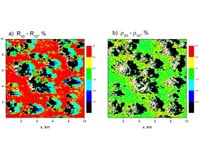
The idea worked. The researchers constructed two images of a patch of cloudy sky using cumbersome computational methods that can subtract out estimated cloud-induced glare. One was based on total reflected light, and the other was based on ratios of how much light was reflected at two different wavelengths.
The ratio image provided a view of the cloudy sky with much better contrast than the reflected light one, indicating that ratios better delineate blue sky from cloud.
But a pretty picture won't help anyone recreate aerosols in a computer model. So the team devised an innovative way to convert the ratios back into aerosol optical depths. The team created a database that related wavelength ratios, particles sizes, number of particles and aerosol optical depth.
From this database, two ratios would allow them to determine their aerosol properties of interest.
The two then determined the accuracy of the ratio method. They selected data from a typical summer day in the southern Great Plains, gathered via the DOE's Atmospheric Radiation Measurement Climate Research Facility (ACRF) in Oklahoma.
Using the ratio method, they retrieved the aerosol optical depth at three wavelengths (470, 660 and 870 nanometers) and compared this to the original data. The ratio method estimated aerosol optical depth under partly cloudy conditions with an error of only about 10 percent.
If the results hold up with additional testing, Kassianov says this approach could be applied to data being collected by NASA's Earth Observing System in skies near clouds.
"Researchers use different models and try to incorporate aerosol effects. The models are so inaccurate that we don't know how much aerosols change cloud properties," he says. "This tool could potentially increase the accuracy of our climate models."