
SPACE MART SPACE DAILY SPACE WAR TERRA DAILY MARS DAILY SPACE TRAVEL GPS DAILY ENERGY DAILY
  Space Industry and Business News  
Get Our Free Newsletters Via Email
  
Search All Our Sites at SpaceBank
Scientists Create Fire-Safe, Green Plastic

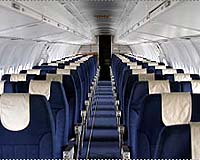
According to the FAA, 40 percent of passengers who survive the impact of an airplane accident die in the fire that follows. The agency requires that aircraft use the most flame-resistant plastics that are available, but "we're shooting for a fire-proof cabin," says Richard Lyon, manager of the FAA's fire research program. "To get there we have to invent plastics that don't yet exist-plastics that don't burn, or burn so slowly that there is ample time for passengers to escape from an aircraft fire," he says.
by Staff Writers
Amherst MA (SPX) May 31, 2007
Scientists from the University of Massachusetts Amherst have created a synthetic polymer-a building block of plastics-that doesn't burn, making it an attractive alternative to traditional plastics, many of which are so flammable they are sometimes referred to as "solid gasoline."

The new polymer wouldn't need the flame-retardant chemicals that are added to many plastics before they can be used in bus seats, airplanes, textiles and countless household items. Some of these additives have been showing up in dust in homes and offices, fish, fat cells and breast milk, raising concern that they pose a risk to human health and the environment. (The state of Washington recently banned a class of flame-retardants from use in household items from mattresses to computers-the first state to do so.)

Led by UMass Amherst scientists Richard Farris, Bryan Coughlin and Todd Emrick, the research team presented an update on their work to industry representatives and scientists from the Federal Aviation Administration (FAA), the National Institute of Standards and Technology and the U.S. Army on May 14. The team described the new polymer in the journal Macromolecules last year.

According to the FAA, 40 percent of passengers who survive the impact of an airplane accident die in the fire that follows. The agency requires that aircraft use the most flame-resistant plastics that are available, but "we're shooting for a fire-proof cabin," says Richard Lyon, manager of the FAA's fire research program. "To get there we have to invent plastics that don't yet exist-plastics that don't burn, or burn so slowly that there is ample time for passengers to escape from an aircraft fire," he says.

When something burns, it decomposes thermally; some of it becomes a gas-that's what burns as flame-and what doesn't burn becomes what polymer scientists refer to as "char"-that's the solid that is left behind. The goal when creating flame-resistant plastics is to have a very high char yield-more char means less fire and fewer volatile chemicals being released. Most common plastics burn readily (polypropylene has a char yield of zero), so fire-retardant additives are mixed in-these often are halogenated molecules that contain reactive chemicals such as chlorine, bromine or phosphorous. These additives have been particularly effective at reducing the flammability of plastics, but have come under increased scrutiny for being potentially damaging to human health and the environment.

The polymer that the UMass Amherst team synthesized has a naturally high char yield (70 percent) and doesn't contain any halogens. It uses bishydroxydeoxybenzoin or BHDB as a building block, which releases water vapor when it breaks down in a fire, rather than hazardous gasses. The synthetic polymer seems to have all the desired qualities of a flame resistant plastic: it is clear, flexible, durable and much cheaper to make than the high-temperature and heat-resistant plastics in current use, which tend to be brittle and dark in color.

"The great thing about BHDB is that it's really a two-birds-with-one-stone approach for a new polymer," says Coughlin. "It is extremely fire-safe, and does not contain halogenated additives, which are known to be environmentally hazardous."

"This is an environmentally friendly solution with a lot of economic potential," says the FAA's Lyon. UMass Amherst's department of polymer science and engineering has a long-standing partnership with the FAA's fire-safety branch.

The next step, say the researchers, is to make a couple of tons of BHDB-enough to make aircraft parts and do more tests. Eventually it may end up in combat gear for soldiers, in circuit boards, bus seats and numerous household products.

"We had to work outside the usual chemistry routes one takes to make something non-flammable," says UMass Amherst's Emrick "It was a challenge, but once we realized BHDB was a useful building block, the synthetic polymer chemistry fell into place."

Email This Article

Related Links
University of Massachusetts Amherst
Space Technology News - Applications and Research

Canon And Toshiba Delay Launch Of New SED Televisions
Tokyo (AFP) May 25, 2007
Japanese high-tech giants Canon and Toshiba said Friday they had decided to postpone indefinitely the launch of a new type of flat television panel which is mired in legal wrangling. SED television sets were due to be introduced in Japan in the fourth quarter of 2007. No new launch date was given.


Memory Foam Mattress Review

Newsletters :: SpaceDaily Express :: SpaceWar Express :: TerraDaily Express :: Energy Daily
XML Feeds :: Space News :: Earth News :: War News :: Solar Energy News
  • Academic Group Releases Plan To Share Power Over Internet Root Zone Keys
  • Satellite Enables Mobile Wireless Broadband Services To Conventional Devices
  • Singapore Airlines Selects Rockwell Collins Satellite Communications
  • Couch Potatoes On Track For Virtual World

  • Proton-M Carrier With US Telecom Satellite To Lift Off In June
  • Microgravity Enterprises Launches Commercial Payload From New Mexico Spaceport
  • Arianespace Maintains Launch Campaign Pace As Another Ariane 5 GEO Truck Takes Form
  • Energia Posts 220 Percent Rise In 2006 Net Profit

  • Australia Fears Jet Flight Guilt Could Hit Tourism
  • Nondestructive Testing Keeps Bagram Aircraft Flying
  • New FAA Oceanic Air Traffic System Designed By Lockheed Martin Fully Operational
  • NASA Seeks New Research Proposals

  • Raytheon Demonstrates Joint C3I Warfighter Interoperability
  • Raytheon's MicroLight Radio Selected For UK Army's FIST Program Testing
  • General Dynamics To Provide Ku-Band Satellite On-the-Move Antenna System To Army
  • Raytheon Awarded USAF Global Broadcast Services Contract

  • Scientists Create Fire-Safe, Green Plastic
  • Canon And Toshiba Delay Launch Of New SED Televisions
  • Quasicrystals: Somewhere Between Order And Disorder
  • Space Technology Creates Investment Opportunities

  • Hall Appoints Feeney To Top GOP Position On Space And Aeronautics Subcommittee
  • Dodgen Joins Northrop Grumman As Vice President Of Strategy For Missile Systems Business
  • Townsend To Lead Ball Aerospace Exploration Systems In Huntsville
  • NASA Nobel Prize Recipient To Lead Chief Scientist Office

  • Tracking A Hot Spot In The Center Of The Biggest Ocean On Earth
  • MetOp-A Takes Up Service
  • General Dynamics Awarded Contract For NASA's Landsat Data Continuity Mission Study
  • ESA Presents The Sharpest Ever Satellite Map Of Earth

  • Latest AeroAstro Asset Tracking Satellite Downlink Decoder Ready For Deployment
  • Russian Satellite Navigation Devices On Sale This Year
  • GNSS And ESA Sign Cooperation Agreement For Satellite Navigation Technologies
  • Putin Makes Glonass Navigation System Free For Customers

  • The content herein, unless otherwise known to be public domain, are Copyright 1995-2006 - SpaceDaily.AFP and UPI Wire Stories are copyright Agence France-Presse and United Press International. ESA PortalReports are copyright European Space Agency. All NASA sourced material is public domain. Additionalcopyrights may apply in whole or part to other bona fide parties. Advertising does not imply endorsement,agreement or approval of any opinions, statements or information provided by SpaceDaily on any Web page published or hosted by SpaceDaily. Privacy Statement