 |
 |
 |
 |
 |
 |
 |
 |
 |

 |
Report Finds Many Benefits From Plug-In Hybrid Electric Vehicles
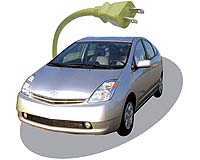
Palo Alto CA (SPX) Jul 23, 2007 The Electric Power Research Institute (EPRI) and the Natural Resources Defense Council (NRDC) today released a comprehensive assessment that finds that widespread use of plug-in hybrid electric vehicles (PHEVs) in the United States could reduce greenhouse gas (GHG) emissions and potential for improve ambient air quality. The research measures the impact of increasing numbers of PHEVs between 2010 and 2050, including the nationwide environmental impact of potentially large fleets that would use electricity from the grid as their primary fuel source. Among study's key findings were: + Widespread adoption of PHEVs can reduce GHG emissions from vehicles by more than 450 million metric tons annually in 2050 -- equivalent to removing 82.5 million passenger cars from the road + There is an abundant supply of electricity for transportation; a 60 percent U.S. market share for PHEVs would use 7 percent to 8 percent of grid-supplied electricity in 2050 + PHEVs can improve nationwide air quality and reduce petroleum consumption by 3 million to 4 million barrels per day in 2050 The analysis is the first to combine detailed models of the U.S. electric system and transportation sector with sophisticated atmospheric air quality models -- accounting for the future evolution of both sectors in technological advances, electricity load growth and capacity expansion. "This research accelerates our understanding of the interplay of emissions from various sources," said Steve Specker, EPRI President and Chief Executive Officer. "We now see that widespread use of PHEVs could expand the fuel options in our transportation sector and at the same time yield net benefits to our environment." The EPRI-NRDC study represents the most comprehensive analysis of the potential reductions of global warming and other emissions from wide-scale introduction of PHEVs over time. The study addresses the impact that lower-emitting electricity generation can have for increasing these benefits. "NRDC believes that a combination of more efficient vehicles, improved battery technology, and a lower-emitting electric power plant fleet can produce substantial reduction in global warming pollution from both the electric power and the transportation sectors, said David Hawkins, Director of NRDC's Climate Center. "Our results show that PHEVs recharged from low- and non-emitting electricity sources can decrease the carbon footprint in the nation's transportation sector." Several benefits result from the use of grid electricity as a transportation fuel. PHEVs can reduce direct emissions at the vehicle tailpipe and indirect emissions at the fuel source when they recharge by electricity produced by a portfolio of efficient combustion, non-emitting or renewable generation. It is this linkage to a cleaner grid that could enable PHEVs to produce less GHG emissions than conventional or hybrid vehicles. Using electricity produced from diverse domestic resources, PHEVs can reduce U.S. dependence on imported oil. The scale of the greenhouse gas benefit from PHEVs will depend on the efficiency of the vehicles, their range on a battery charge and the greenhouse gas emissions from the electric generation fleet. "The EPRI-NRDC study demonstrates that plug-in hybrid electric vehicles can contribute significantly to the national effort to reduce greenhouse gas emissions," said John E. Bryson, chairman and CEO of Edison International. "With public support, it is likely that someday millions of Americans will fill up their vehicles at the plug instead of the pump, saving money and protecting the environment." Plug-in hybrid electric vehicles combine operational aspects of both battery electric vehicles (BEVs) and power assist hybrid electric vehicles (HEVs). A PHEV, like a BEV, can be recharged from the electric grid, stores energy in an onboard battery and uses the energy while depleting the battery during daily driving. Unlike a BEV, a PHEV can use its internal combustion engine for propulsion in highway driving or when the battery is depleted. Because of this versatility, a PHEV can serve as a direct replacement for a conventional internal combustion engine vehicle or HEV. Related Links Natural Resources Defense Council Electric Power Research Institute Car Technology at SpaceMart.com
 New Research Seeks To Enhance Alternative Fuel Integration In Public Vehicle Fleets
 Rochester NY (SPX) Jul 18, 2007
Rochester Institute of Technology and the County of Monroe, New York have created a research partnership to assess the performance of the County's fleet of E85 flex-fuel vehicles. E85 is comprised of 85% ethanol and 15% gasoline and is considered a major alternative energy option for American automobiles. |
|
|

| The content herein, unless otherwise known to be public domain, are Copyright Space.TV Corporation. AFP and UPI Wire Stories are copyright Agence France-Presse and United Press International. ESA Portal Reports are copyright European Space Agency. All NASA sourced material is public domain. Additional copyrights may apply in whole or part to other bona fide parties. Advertising does not imply endorsement, agreement or approval of any opinions, statements or information provided by Space.TV Corp on any Web page published or hosted by Space.TV Corp. Privacy Statement |