 |
 |
 |
 |
 |
 |
 |
 |
 |

 |
Pitt Researchers Create New Form Of Matter
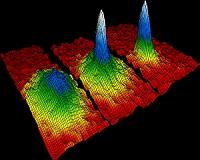
Pittsburgh PA (SPX) May 22, 2007 Physicists at the University of Pittsburgh have demonstrated a new form of matter that melds the characteristics of lasers with those of the world's best electrical conductors. The work introduces a new method of moving energy from one point to another as well as a low-energy means of producing a light beam like that from a laser. The Pitt researchers and their collaborators at the Bell Labs of Alcatel-Lucent in New Jersey detail the process in the May 18 issue of the journal Science. The new state is a solid filled with a collection of energy particles known as polaritons that have been trapped and slowed, explained lead investigator David Snoke, an associate professor in the physics and astronomy department in Pitt's School of Arts and Sciences. Snoke worked with Pitt graduate students Ryan Balili and Vincent Hartwell on the project. Using specially designed optical structures with nanometer-thick layers-which allow polaritons to move freely inside the solid - Snoke and his colleagues captured the polaritons in the form of a superfluid. In superfluids and in their solid counterparts, superconductors, matter consolidates to act as a single energy wave rather than as individual particles. In superconductors, this allows for the perfect flow of electricity. In the new state of matter demonstrated at Pitt-which can be called a polariton superfluid-the wave behavior leads to a pure light beam similar to that from a laser but is much more energy efficient. Traditional superfluids and superconductors require extremely low temperatures, approximately negative 280 and negative 450 degrees Fahrenheit for a superconductor and superfluid, respectively. The polariton superfluid is more stable at higher temperatures, and may be capable of being demonstrated at room temperature in the near future. The Pitt research builds on current efforts in physics laboratories around the world to create materials, which mix the characteristics of superconductors and lasers. Snoke's work provides a new method to trap and manipulate the energy particles. Applied to technology, this technique could provide new ways of controlled transfer of optical signals through solid matter. Snoke's polariton trap was devised with a technique similar to that used for superfluids made of atoms in a gaseous state known as the Bose-Einstein condensate. Three scientists shared the 2001 Nobel Prize in Physics for producing the condensate. Related Links University of Pittsburgh Space Technology News - Applications and Research
 From Ink To Optics, Study Of Particle Mixtures Yields Fundamental Insights
 Princeton NJ (SPX) May 18, 2007
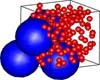
Since the invention of ink over 3,000 years ago, people have exploited the unique properties of colloids, in which particles of one substance are suspended in another. Now, Princeton University chemical engineers have answered a fundamental question about these mixtures in work that may have wide-ranging practical applications, including the manufacturing of medicines and optical fibers. |
|
|

| The content herein, unless otherwise known to be public domain, are Copyright Space.TV Corporation. AFP and UPI Wire Stories are copyright Agence France-Presse and United Press International. ESA Portal Reports are copyright European Space Agency. All NASA sourced material is public domain. Additional copyrights may apply in whole or part to other bona fide parties. Advertising does not imply endorsement, agreement or approval of any opinions, statements or information provided by Space.TV Corp on any Web page published or hosted by Space.TV Corp. Privacy Statement |