 |
 |
 |
 |
 |
 |
 |
 |
 |

 |
New Metal Crystals Formed On A Cotton Assembly Line
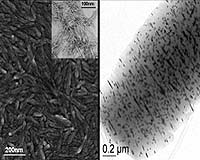
Chicago IL (SPX) Mar 28, 2007 Appropriating cellulose fibers from cotton and crystallizing them, scientists at Pacific Northwest National Laboratory have grown never-before-seen configurations of metal crystals that show promise as components in biosensors, biological imaging, drug delivery and catalytic converters. Deriving the desired chemical and physical properties necessary for those applications hinges on the uniform size of the metal crystals. Depending on the metal, they must be between 2 and 200 nanometers, Yongsoon Shin, a staff scientist at the Department of Energy laboratory in Richland, Wash., reported Monday at the national meeting of the American Chemical Society. PNNL laboratory fellow Gregory Exarhos led the research. Exarhos called Shin's experimental work "the first report of the efficacy of nanocrystalline cellulose templates in driving the formation of ordered metal and metal oxide nanoparticles at surfaces." Exarhos has dubbed these cellulose nanocrystals "molecular factories." Using acid-treated cellulose fibers from cotton as a natural template, the PNNL team has been able to grow gold, silver, palladium, platinum, copper, nickel and other metal and metal-oxide nanocrystals quickly and of uniform size, Shin said. The metals display catalytic, electrical and optical that would not be present in larger or odd-sized crystals. The acid converts the cellulose to a large, stable crystallized molecule rich in oxygen-hydrogen, or hydroxyl, groups, predictably spaced along the long chemical chains, or polymers, that comprise the cellulose molecule's backbone. When most metal salts dissolved in solution are added in a pressurized oven and heated 70 to 200 degrees centigrade or warmer for four to 16 hours, uniform metal crystals form at the hydroxyl sites. The researchers called this method a "green process," requiring only heat, the crystalline cellulose and the metal salts. Other attempts to get uniform nanometals have resulted in crystals of widely variable sizes that require strong, caustic chemicals as reducing and stabilizing agents. "We have some preliminary catalytic results," Shin said, involving "coupling reactions of organic molecules for palladium and UV-irradiated degradation of organic dyes in water with selenium metals. "Smaller particles-15 to 20 nanometers-showed faster and higher catalytic conversion ratio compared to commercial catalysts." Related Links DOE/Pacific Northwest National Laboratory All about the technology of space and more Space Technology News - Applications and Research
 Top 10 Materials Moments In History Announced
 Warrendale PA (SPX) Mar 09, 2007
More than 4,200 materials science and engineering professionals from 68 countries attended the TMS 2007 Annual Meeting and Exhibition in Orlando, Florida, Feb. 25-March 1, as the results of voting among the scientific community and the public at large revealed the Greatest Materials Moments in History. The Periodic Table of Elements devised by Dmitri Mendeleev in 1864 was voted the number one materials moment, the indispensable reference tool for those in the field. (See below for remaining top 10.) |
|
|

| The content herein, unless otherwise known to be public domain, are Copyright Space.TV Corporation. AFP and UPI Wire Stories are copyright Agence France-Presse and United Press International. ESA Portal Reports are copyright European Space Agency. All NASA sourced material is public domain. Additional copyrights may apply in whole or part to other bona fide parties. Advertising does not imply endorsement, agreement or approval of any opinions, statements or information provided by Space.TV Corp on any Web page published or hosted by Space.TV Corp. Privacy Statement |