 |
 |
 |
 |
 |
 |
 |
 |
 |

 |
Nanotube Flickering Reveals Single-Molecule Rendezvous
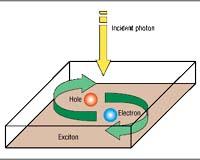
Houston TX (SPX) Jun 11, 2007 In the quantum world, photons and electrons dance, bump and carry out transactions that govern everything we see in the world around us. In this week's issue of Science, French and U.S. scientists describe a new technique in nanotechnology that allowed them to zoom in -- way in -- and observe those quantum transactions on a single DNA-sized carbon molecule called a nanotube. The team, led by Rice University chemist Bruce Weisman and University of Bordeaux physicist Laurent Cognet, focused on short-lived quantum oddities called "excitons," which are created when light hits a semiconductor. "Excitons in carbon nanotubes only last about 100 trillionths of a second," Weisman said. "They wink out of existence when the nanotube emits a photon of fluorescent light, but during their short lifetimes they can move around." To study exciton mobility on nanotubes, Cognet and his co-workers conducted experiments during a sabbatical visit to Weisman's lab at Rice in early 2007. They used a fluorescence microscope to observe tiny sections of individual nanotubes less than a micrometer long. The nanotubes were held still in a soft liquid gel. By shining light on them while introducing acids and other chemicals into the gel, the team was able to observe reactions that would quench, or kill, any passing excitons. To do this, they used a time-lapse infrared camera to capture the fluorescent glow from the nanotube about 20 times a second. They then compiled records that revealed the characteristic steps that are the signature of exciton quenching by single molecules. "We found that each nanotube exciton travels about 90 nanometers and visits some 10,000 carbon atoms during its lifespan," Cognet said. Excitons are "quasiparticles" created when a photon strikes a semiconductor and excites an electron to a higher energy level. The electron leaves behind a positively charged void called a "hole." That hole pairs with the electron to form the exciton, which takes on a life of its own that ends abruptly when it emits a photon or becomes quenched. Cognet said the unusual electronic properties of carbon nanotubes made them a unique system to observe single-molecule reactions. "Nanotubes provided us a very stable baseline for our measurements," he said. "No other light-emitting molecules have the properties that we needed for this experiment." Weisman helped found the field of nanotube spectroscopy with the 2002 discovery of nanotube fluorescence and subsequent research that classified the light signatures of dozens of types of semiconducting nanotubes. "I was impressed at the speed and quality of the work that Dr. Cognet and the team produced during this project," said Weisman, professor of chemistry. "His visit to Rice has been extremely productive." Related Links Rice University Nano Technology News From SpaceMart.com Computer Chip Architecture, Technology and Manufacture
 Silicon Nanowires Upgrade Data-Storage Technology
 Washington DC (SPX) Jun 11, 2007
Scientists at the National Institute of Standards and Technology (NIST), along with colleagues at George Mason University and Kwangwoon University in Korea, have fabricated a memory device that combines silicon nanowires with a more traditional type of data-storage. Their hybrid structure may be more reliable than other nanowire-based memory devices recently built and more easily integrated into commercial applications. |
|
|

| The content herein, unless otherwise known to be public domain, are Copyright Space.TV Corporation. AFP and UPI Wire Stories are copyright Agence France-Presse and United Press International. ESA Portal Reports are copyright European Space Agency. All NASA sourced material is public domain. Additional copyrights may apply in whole or part to other bona fide parties. Advertising does not imply endorsement, agreement or approval of any opinions, statements or information provided by Space.TV Corp on any Web page published or hosted by Space.TV Corp. Privacy Statement |