 |
 |
 |
 |
 |
 |
 |
 |
 |

 |
ESA's New Scientific Heart Inaugurated By Spanish Royalty
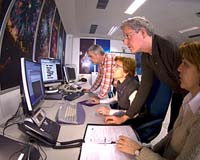
Madrid, Spain (ESA) Feb 08, 2008 Their Royal Highnesses The Prince and Princess of Asturias inaugurated this afternoon ESA's European Space Astronomy Centre (ESAC), located on the outskirts of Madrid, Spain. The event was also attended by the Spanish Minister for Industry, Joan Clos; the Head of the Spanish Delegation to ESA, Mauricio Lucena; and ESA's Director of Science, David Southwood, as well as by representatives of central, regional and local Governments and the aerospace sector. ESAC is ESA's new base for astrophysical and Solar System missions, and is a centre of excellence for space science, and meeting point for scientists and researchers from all over the world. ESAC hosts the Science Operations Centres of the following missions: XMM-Newton, Integral, Akari (a Japanese-led mission), Herschel, Planck, Gaia, LISA Pathfinder, Mars Express, Venus Express and Rosetta. ESAC also houses the scientific archives of IUE, ISO, XMM-Newton and Integral, together with precious scientific data from Mars, Venus and Titan obtained by ESA's Mars Express, Venus Express and Huygens spacecraft. In the near future, ESAC will also be the scientific centre of ESA's mission to Mercury, BepiColombo. Other future programmes at ESAC will include the NASA-led James Webb Space Telescope, the successor to Hubble. Beyond its fundamental scientific role, ESAC will also take part in ESA's space application programmes. SMOS (Soil Moisture and Ocean Salinity), an ESA Earth Observation mission to measure soil and sea characteristics, will be launched this year, and ESAC will host the data centre for this satellite, thus embarking on a new role in the field of Earth Observation. Prince Felipe and Princess Letizia arrived at ESAC at noon. In front of over 120 distinguished guests and after a few words by the Minister and ESA's Director of Science, Prince Felipe unveiled a plaque, engraved with the words 'Their Royal Highnesses The Prince and Princess of Asturias inaugurated the European Space Astronomy Centre of the European Space Agency. 7 February 2008'. ESAC Director Vicente Gomez, as host of the celebration, graciously thanked the Prince and the Princess for their visit. The Prince and Princess were given a brief tour of the facilities, escorted by the dignitaries and ESA experts. Prince Felipe and Princess Letizia visited the ESAC Planning Room and the Control Room of ESA's X-ray space telescope XMM-Newton. XMM-Newton's observations of black holes (stars that have died as supernovae), and energetic astrophysical phenomena in general, are opening entirely new fields in astronomy. The Prince and Princess then signed ESAC's Honoured Guest Book before ending their visit meeting with guests and ESAC staff during a cocktail party. Related Links ESAC The latest information about the Commercial Satellite Industry
 Countdown To Columbus Launch Continues
 Paris, France (ESA) Feb 07, 2008
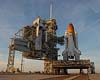
The countdown continues towards Thursday's launch of the European Columbus laboratory on board Space Shuttle Atlantis. Weather forecasts for the launch site in Florida currently predict a 70 percent chance of unfavourable weather at launch time. Atlantis is scheduled for liftoff at 20:45 CET (19:45 UT). |
|
|

| The content herein, unless otherwise known to be public domain, are Copyright Space.TV Corporation. AFP and UPI Wire Stories are copyright Agence France-Presse and United Press International. ESA Portal Reports are copyright European Space Agency. All NASA sourced material is public domain. Additional copyrights may apply in whole or part to other bona fide parties. Advertising does not imply endorsement, agreement or approval of any opinions, statements or information provided by Space.TV Corp on any Web page published or hosted by Space.TV Corp. Privacy Statement |