 |
 |
 |
 |
 |
 |
 |
 |
 |

 |
Cornell Wins A NASA Launch For Nano Satellite
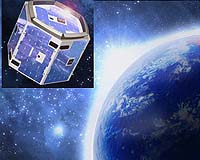
Ithaca NY (SPX) Apr 10, 2007 Over the past two years, Cornell's CUSat satellite project has engaged and educated a parade of engineering students, sometimes changing their careers. Now the final product -- an innovative experiment in outer space maneuvering and inspecting -- has received the go-ahead for a NASA launch into orbit. Cornell's CUSat was chosen March 27 as the winner of the University Nanosatellite Program's Nanosat-4 competition sponsored by the Air Force and the American Institute of Aeronautics and Astronautics, and will fulfill the project's catchphrase -- a paraphrase of the school's alma mater -- by rising "far, far above Cayuga's waters." "The purse represented by this prize is probably the biggest ever received here," said Mason Peck, assistant professor of mechanical and aerospace engineering and principal investigator on the project. "The prize is a free launch, worth millions of dollars." Cornell's satellite was chosen from among 11 entries by a panel of 20 government and industry judges based on student participation, the flight-worthiness of the design and relevance of the mission to NASA and the Air Force. "Robustness was one of the factors that helped us win, but the judges also said it would be a very relevant mission," Peck said. "There is new stuff being done here, with new results NASA cares about. We're not just flying a brick." CUSat is actually two identical satellites linked into a hexagonal package, weighing about 90 pounds. Once in orbit the two satellites will separate and orbit each other, about 10 yards apart. Using highly refined global positioning system (GPS) devices, one satellite will orient itself toward the other and relay pictures of it to a ground station in Ithaca, where a 3-D model of the target satellite will be constructed. Such a system could be used to diagnose problems with future spacecraft, including examination of tiles on the space shuttle. For navigation, CUSat uses signals from orbiting GPS satellites. Ordinarily these signals can locate an object to within a few feet. CUSat uses algorithms developed by Mark Psiaki, associate professor of mechanical and aerospace engineering, and his Ph.D. student Shan Mohiuddin, that provide accuracy down to a few inches. Peck credits Professor Mark Campbell with the design of the satellite's thrusters, which burn solid Teflon, a much safer system than compressed gas. Campbell and Psiaki also help advise the team; Kris Young, M.Eng. '07, is student program manager. About 80 students currently work on the project, Peck said, but about 225 have been involved over the past two years. Although the project has received about $160,000 from the University Nanosatellite Program, engineering alumni and the College of Engineering as well as hardware and other assistance from many corporate sponsors, the biggest contribution has been student time, he said. "If they were practicing engineers it would add up to millions," he said. "They're really passionate about spacecraft," he added, "and they have been heavily recruited by NASA and the aerospace industry. In many cases this opportunity has helped shape their careers." For the competition Cornell submitted a partially completed model in which at least one of every element had been built, demonstrating that the team could complete every aspect of the project. "All we need now is money," Peck said. The win brought additional funding of $110,000, but to complete the satellite and make it ready for launch will require up to half a million dollars, he said, so the program is eagerly seeking more sponsors. One possibility, he said, is to find a company that wants to add its own experiment to the satellite, to be carried out after the main mission is done. There will probably be a wait of at least two years for the launch, Peck said. For more information on the project and the satellite team, visit http://cusat.cornell.edu Related Links Cornell University All about the technology of space and more Space Technology News - Applications and Research
 Vietnam Establishes Space Technology Institute
 Hanoi (XNA) Apr 04, 2007
Vietnam's Space Technology Institute, which is mainly involved in developing satellite technologies, equipment, remote sensing technology and application, and space dynamics, was inaugurated Tuesday. |
|
|

| The content herein, unless otherwise known to be public domain, are Copyright Space.TV Corporation. AFP and UPI Wire Stories are copyright Agence France-Presse and United Press International. ESA Portal Reports are copyright European Space Agency. All NASA sourced material is public domain. Additional copyrights may apply in whole or part to other bona fide parties. Advertising does not imply endorsement, agreement or approval of any opinions, statements or information provided by Space.TV Corp on any Web page published or hosted by Space.TV Corp. Privacy Statement |