
SPACE MART SPACE DAILY SPACE WAR TERRA DAILY MARS DAILY SPACE TRAVEL GPS DAILY ENERGY DAILY
  Space Industry and Business News  
Get Our Free Newsletters Via Email
  
Search All Our Sites at SpaceBank
Boeing Orbital Express Achieves Another First In Space

After completing the fly-around, ASTRO maintained its relative position with NextSat at 120 meters for 17 minutes then maneuvered above NextSat to perform a corridor approach to within centimeters of the client spacecraft. The capture mechanism grappled NextSat and performed a soft berth, drawing NextSat and ASTRO together.
by Staff Writers
St. Louis MO (SPX) Jun 25, 2007
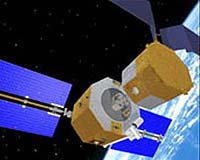
Boeing reports that the Orbital Express system, a program to validate spacecraft servicing capability led by the Defense Advanced Research Projects Agency (DARPA), has performed a fully-autonomous "fly-around and capture" of its NextSat client spacecraft, marking another industry first for the innovative program.

During the five-hour test on June 16, Boeing's Autonomous Space Transport Robotic Operations (ASTRO) servicing spacecraft used its onboard cameras and advanced video guidance system to separate from, circle and re-mate with the Ball Aerospace NextSat client spacecraft. The test primarily used passive sensors with no active exchange of relative navigation information or involvement by ground controllers.

Positioned in orbit 60 meters above NextSat, ASTRO followed an imaginary line called the "Rbar," which extends from the Earth's center to a satellite and beyond, to capture the spacecraft. The maneuver simulated the direction of approach needed to effectively service a satellite without interfering with its cameras or antennas.

"This scenario validated autonomous fly-around capability, which is needed for inspecting spacecraft," said Alex Lopez, vice president of Boeing Advanced Network and Space Systems. "The team also proved that approaching a satellite from 'minus Rbar' means that Orbital Express can conduct on-orbit servicing operations without disrupting satellite service for customers. This capability is considered highly desirable by satellite operators."

ASTRO and NextSat began the demonstration (Scenario 5-1) in the Mated Nominal mode. At the predicted time, ASTRO's autonomous systems separated it from NextSat to a range of up to 120 meters. ASTRO then circled NextSat using its sensor systems to continuously track NextSat during the fly-around. If sensor inputs had deviated outside of the established limits, an autonomous safing action would have repositioned the spacecraft to a safe location.

After completing the fly-around, ASTRO maintained its relative position with NextSat at 120 meters for 17 minutes then maneuvered above NextSat to perform a corridor approach to within centimeters of the client spacecraft. The capture mechanism grappled NextSat and performed a soft berth, drawing NextSat and ASTRO together.

The test marked the first unmated operation since mid-May when the Orbital Express team experienced a computer sensor anomaly during the unmated portion of Scenario 3-1. The system's autonomous safing feature maneuvered the spacecraft to a safe location until the team could re-mate them. The team has since resolved the anomaly from this scenario.

During the next major unmated operation (Scenario 7-1), ASTRO will depart NextSat to a range of four kilometers before approaching the client spacecraft and performing a free-fly capture using its robotic arm.

Orbital Express team members include NASA, Ball Aerospace, Northrop Grumman Space Technology, MacDonald, Dettwiler and Associates Ltd., the Charles Stark Draper Laboratory Inc., and Starsys Research.

Community
Email This Article
Comment On This Article

Related Links
Orbital Express at Boeing
Space Technology News - Applications and Research


ESA And Inmarsat Prepare For Alphasat
Paris, France (ESA) Jun 20, 2007
Today at the Paris Air Show, ESA and Inmarsat moved closer to the implementation of Alphasat, the first satellite based on Alphabus, the new European telecommunications platform. Alphabus is a programme initiated by ESA and CNES to jointly develop a product through a project industrial team made of EADS Astrium and Thales Alenia Space. It is a new multi-purpose platform for the high-power payload communications satellite market.


Memory Foam Mattress Review

Newsletters :: SpaceDaily Express :: SpaceWar Express :: TerraDaily Express :: Energy Daily
XML Feeds :: Space News :: Earth News :: War News :: Solar Energy News
  • Rockwell Collins And ARINC Sign Agreement For Broadband Offering

  • Arianespace Winning Launch Contracts From Across The World
  • 2006 Bumper Year For Satellite Launcher Arianespace
  • SES Signs For Five ILS Protons Through 2013
  • ILS Wins Arabsat-5A Contract To Launch On Proton Breeze M

  • F-35 Lightning 2 Pushing Ahead On All Fronts
  • EU And US Launch Airline Pollution Initiative
  • Airbus Wants To Cut CO2 Emissions By Half By 2020
  • easyJet Plans Greener Aircraft By 2015

  • Boeing Showcases Operational TSAT System During Critical Review
  • Lockheed Martin Shifts Into Production Phase Of Navy Narrowband Tactical Satellite
  • Major Integration Milestone Achieved On Advanced Military Communications Satellite
  • First Wideband Global SATCOM Satellite Packed And Ready For Shipment

  • SpaceDev To Develop Deployable Structures Technology For AFRL
  • Boeing Orbital Express Achieves Another First In Space
  • ESA And Inmarsat Prepare For Alphasat
  • Scientists Demonstrate High-Performing Room-Temperature Nanolaser


  • QuikSCAT Marks Eight Years On-Orbit Watching Planet Earth
  • Ukraine To Launch Earth Observation Satellite In 2008
  • NASA Satellites Watch as China Constructs Giant Dam
  • Boeing Launches Italian Earth Observation Satellite

  • GPS Wing At LA Air Force Base Changes Command
  • ESA Launches New Program For Air Traffic Management Via Satellite
  • Northrop Grumman Delivers First Production Stellar Navigation System To US Air Force
  • AeroAstro Extends Globalstar Simplex Data Service Eastern Australia And New Zealand

  • The content herein, unless otherwise known to be public domain, are Copyright 1995-2006 - SpaceDaily.AFP and UPI Wire Stories are copyright Agence France-Presse and United Press International. ESA PortalReports are copyright European Space Agency. All NASA sourced material is public domain. Additionalcopyrights may apply in whole or part to other bona fide parties. Advertising does not imply endorsement,agreement or approval of any opinions, statements or information provided by SpaceDaily on any Web page published or hosted by SpaceDaily. Privacy Statement