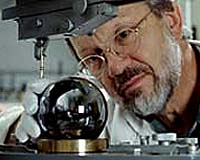
Australian scientists and optical engineers will be making a perfect sphere that may one day re-define the kilogram – and tomorrow they're taking delivery of the cylinder of silicon from which it will be made. The kilogram is one of seven base units in the International System (SI) used in science, commerce and everyday life.
However, it is the only one still defined by a physical object – a lump of metal, known as the International Prototype, sitting in a vault in France. All the others have moved with the scientific times and are defined in terms of a fundamental constant of nature so anyone anywhere can reproduce them and they do not change over time.
Under the auspices of the International Bureau of Weights and Measures (BIPM), near Paris, the decision has been made that international effort will focus on two ways of re-defining the kilogram: one of which involves making a perfect sphere from a single crystal of exceptionally pure silicon.
The work will be done with the close cooperation of Australia's National Measurement Institute (NMI) and CSIRO's Australian Centre for Precision Optics (ACPO), which share the same site in the Sydney suburb of Lindfield.
While a physical object will still be necessary for calibrating scales and balances, the silicon atoms in the sphere will always remain the same. It is for this reason that the scientists working on what's known as the Avogadro Project are collaborating to determine what is effectively the number of atoms in a sphere. Once the number of atoms is known, the definition of the kilogram can be based on it from then on.
The best sphere the ACPO team has made had a total out-of-roundness of 35 nanometres. That is, the diameter varies by an average of only 35 millionths of a millimetre, making it probably the roundest object in the world.
"The only people who can make what is likely to be the roundest object in the world are our colleagues at CSIRO's ACPO," Dr Barry Inglis, Chief Executive of NMI says.
Mr Alain Picard of the BIPM, who is bringing the silicon to Australia, says: "My laboratory has maintained the International Prototype kilogram since 1889. We are really pleased that this international collaboration will finally let us improve the definition of the unit of mass by basing it on a physical constant."
Ms Katie Green is part of ACPO's team of expert optical engineers who will fabricate the spheres and Mr Walter Giardini of NMI lends skills in precision measurement to the project.
It has taken three years to produce the 20 cm long cylinder of silicon. The special silicon, known as monoisotopic silicon, was made in Russia and grown into a near perfect crystal in Germany. It will take something like twelve weeks to make one sphere 93 mm in diameter (the team will make two).