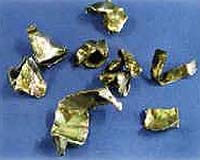
Scientists at Carnegie's Geophysical Laboratory have discovered a new type of phase transition-a change from one form to another-in vanadium, a metal that is commonly added to steel to make it harder and more durable. Under extremely high pressures, pure vanadium crystals change their shape but do not take up less space as a result, unlike most other elements that undergo phase transitions. The work appears in the February 23 issue of Physical Review Letters.
Led by High Pressure Collaborative Access Team (HPCAT) research scientist Yang Ding, the team* used a diamond anvil cell to subject vanadium crystals to pressures more than 600 thousand times higher than the atmospheric pressure at sea level (which is about one bar). Using the high-resolution HPCAT x-ray facility, the scientists were able to detect that the basic atomic packing units of vanadium crystals had changed from a cube to a rhombohedron, which resembles a cube whose sides have been squashed from squares into diamond shapes.
"Trying to understand why high-pressure vanadium uniquely has the record-high superconducting temperature of all known elements inspired us to study high-pressure structure of vanadium," Ding said. "We had no idea that we would discover a completely new type of phase transition."
The most familiar phase transitions are those between gas, liquid, and solid forms. In general, increasing pressure and decreasing temperature will cause a substance to take up less space and eventually form a solid. But as a result of their atoms packing in closer together at extremely high pressures, some solids undergo further changes in their physical properties and can even change shape, which usually results in a change in volume. But in this respect, vanadium is unique.
Though it is expensive to mine and refine, vanadium is extremely important in the industrial world, where its main use is as a steel additive. Steel that contains vanadium is exceptionally strong and resistant to metal fatigue, making it ideal for kitchen knives that stay sharp almost indefinitely, and jet turbine blades that can withstand high speed and abrasion.
Pure vanadium crystals in cubic form were thought to be able to resist pressures over several million bars. Recent theoretical calculations, however, suggested that pressure could cause unusual electronic interactions in vanadium that would destroy the cubic crystals. Instead, vanadium avoids this collapse by changing to a rhombohedron.
"Although this type of transition was first observed in vanadium, it suggests that we should reexamine many other elements we thought were very stable," Ding explained. "Moreover, the transition provides a new explanation for the continuous rising of superconducting temperature in high-pressure vanadium, and could lead us to the next breakthrough in superconducting materials."