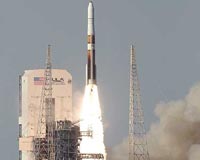
Rising above the two lightning towers around the pad, a Delta IV rocket races into the sky with the GOES-O satellite aboard. Photo credit: NASA/Kim Shiflett
Rising above the two lightning towers around the pad, a Delta IV rocket races into the sky with the GOES-O satellite aboard. Photo credit: NASA/Kim Shiflett |
The GOES-O weather satellite is on its own following a successful separation from the Delta IV second stage. The separation occurred soon after the second stage performed the final of three burns to place the GOES-O spacecraft in a transfer orbit that will eventually reach about 22,300 miles above Earth.
The satellite will be checked out through a series of tests in coming weeks. The GOES-O launched from Cape Canaveral Air Force Station, Fla., at 6:51 p.m. EDT aboard a Delta IV rocket.
GOES-O is the latest weather satellite developed by NASA to aid the nation's meteorologists and climate scientists. The acronym stands for Geostationary Operational Environmental Satellite.
The spacecraft in the series provide the familiar weather pictures seen on United States television newscasts every day. The satellites are equipped with a formidable array of sensors and instruments.
GOES provides nearly continuous imaging and sounding, which allows forecasters to better measure changes in atmospheric temperature and moisture distributions, hence increasing the accuracy of their forecasts. GOES environmental information is used for a host of applications, including weather monitoring and prediction models.
Share This Article With Planet Earth
 del.icio.us del.icio.us |
 Digg Digg |
 Reddit Reddit |
 YahooMyWeb YahooMyWeb |
 Google Google |
 Facebook Facebook |

 QuikScat Finds Tempests Brewing In Ordinary Storms
| The content herein, unless otherwise known to be public domain, are Copyright 1995-2009 - SpaceDaily. AFP and UPI Wire Stories are copyright Agence France-Presse and United Press International. ESA Portal Reports are copyright European Space Agency. All NASA sourced material is public domain. Additional copyrights may apply in whole or part to other bona fide parties. Advertising does not imply endorsement,agreement or approval of any opinions, statements or information provided by SpaceDaily on any Web page published or hosted by SpaceDaily. Privacy Statement |