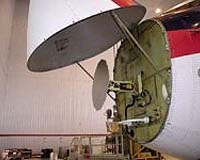
Installation of a modified radar unit that can detect turbulence associated with thunderstorms by measuring the motions of the moisture in the air. (Image credit: AeroTech Research (U.S.A.), Inc.)
Installation of a modified radar unit that can detect turbulence associated with thunderstorms by measuring the motions of the moisture in the air. (Image credit: AeroTech Research (U.S.A.), Inc.) |
Statistics also show that turbulence encounters by commercial transports are the leading cause of injuries to passengers and flight crews in non-fatal airline accidents. Between injury and equipment damage, airlines face more than $100 million in turbulence-related costs each year.
Turbulence happens when an irregular or disturbed flow in the atmosphere produces gusts and eddies. Normally this can't even be seen. Onboard radar systems that track weather can't detect it, even though nearly 80 percent of all turbulence-related accidents are associated with thunderstorm activity.
But don't just blame the weather. Clear-air turbulence can happen from jet streams or even air that passes over mountains and other high obstructions. Nearby planes and helicopters can produce wakes, especially in areas with many take offs and landings.
A team of researchers at NASA's Langley Research Center have worked with industry partners to develop two special tools that can provide real-time alerts about potentially hazardous turbulence. By measuring the movement of moisture in the air, this specialized software enhances the predictive Doppler wind shear systems already in use.
The first technology uses software in an aircraft's radar to give flight crews advance warning of turbulence. This allows the crew to avoid the turbulence altogether, or to at least prepare for it by stowing loose equipment and having passengers and crew buckle into their seats.
The second technology uses software to provide better information about the location and severity of turbulence. When an aircraft encounters turbulence above a certain level, the onboard software generates a report that is broadcast over a data link. Ground stations receive the report and use the Internet to display it to dispatchers, controllers, airline operations personnel, and maintenance crews. If other aircraft are approaching the turbulence, the ground station can send them the data.
Initial flight testing of the technologies was conducted on NASA's B-757 research aircraft. The B-757 was flown through thunderstorm turbulence. The resulting flight data allowed a full evaluation of the systems' performances, ensuring that the technologies were ready for commercial application.
NASA and its partners also worked with Delta Air Lines to evaluate the effectiveness of the system. The software was implemented on a total of 123 Delta Boeing 737-800, 767-300ER, and 767-400ER aircraft. In addition to improved flight safety, this technology helps to manage airspace more effectively, which may lead to more fuel savings and fewer flight delays. It may also help meteorologists validate and improve weather forecasts.
Better turbulence tools help avoid crying "wolf" about when it's important to be seated or when it's safe to move about the cabin. That can be a relief when you need a bathroom break at 30,000 feet.
Read the entire article in Spinoff 2006
Related Links
 EAA AirVenture 2007
 Oshkosh WI (SPX) Jul 25, 2007
| The content herein, unless otherwise known to be public domain, are Copyright Space.TV Corporation. AFP and UPI Wire Stories are copyright Agence France-Presse and United Press International. ESA Portal Reports are copyright European Space Agency. All NASA sourced material is public domain. Additional copyrights may apply in whole or part to other bona fide parties. Advertising does not imply endorsement, agreement or approval of any opinions, statements or information provided by Space.TV Corp on any Web page published or hosted by Space.TV Corp. Privacy Statement |