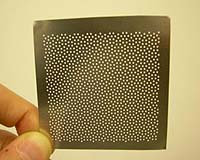
Quasicrystals are found in certain metal alloys that tend to resist wear and corrosion, and are used in non-stick coatings, for example. They also have high tensile strength, meaning high forces are required to stretch them to their breaking point.
Quasicrystals are found in certain metal alloys that tend to resist wear and corrosion, and are used in non-stick coatings, for example. They also have high tensile strength, meaning high forces are required to stretch them to their breaking point. |
A computer simulation performed by University of Michigan scientists has given new insights into how this unique class of solids forms. Quasicrystals incorporate clusters of atoms as they are, without rearranging them as regular crystals do, said Sharon Glotzer, a professor in the Department of Chemical Engineering.
Crystals form when liquids freeze into solids. When a normal crystal grows, a crystallite nucleus develops first. The atoms in the liquid attach one-by-one to the crystallite, as though following a template. If the atoms have already formed a cluster on their own, they must rearrange in order to fit the template. This is how a repeating pattern forms.
In the case of quasicrystals, though, atoms that have already formed stable shapes away from the crystallite can still bind to it. They don't have to make adjustments.
"In our simulations of quasicrystals, we observed that the atoms attach to the crystallite in large groups," said chemical engineering doctoral student Aaron Keys. "These groups have already formed locally stable arrangements, and the growing quasicrystal assimilates them with minimal rearrangement."
Because quasicrystals aren't as regimented as regular crystals, the solid can reach a "structural compromise," where liquid-like molecular arrangements are retained in the solid state. This allows quasicrystals to form more easily than regular crystals.
Quasicrystals are found in certain metal alloys that tend to resist wear and corrosion, and are used in non-stick coatings, for example. They also have high tensile strength, meaning high forces are required to stretch them to their breaking point.
"Learning how they grow will help us figure out to how engineer quasicrystalline structures from new building blocks, which could lead to a slew of new materials," Glotzer said.
Glotzer and Keys are authors of a paper on the research, "How do quasicrystals grow"," published in Physical Review Letters. Their paper is featured in an article in the current edition of the journal Nature.
Glotzer is also a professor in the departments of Materials Science and Engineering, Macromolecular Science and Engineering, and Physics.
Related Links
 Darkest material developed in lab
 Troy, N.Y. (UPI) Feb 20, 2008
| The content herein, unless otherwise known to be public domain, are Copyright Space.TV Corporation. AFP and UPI Wire Stories are copyright Agence France-Presse and United Press International. ESA Portal Reports are copyright European Space Agency. All NASA sourced material is public domain. Additional copyrights may apply in whole or part to other bona fide parties. Advertising does not imply endorsement, agreement or approval of any opinions, statements or information provided by Space.TV Corp on any Web page published or hosted by Space.TV Corp. Privacy Statement |