 |
 |
 |
 |
 |
 |
 |
 |
 |

 |
Giant Magnetocaloric Materials Could Have Large Impact On The Environment
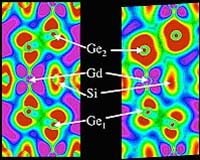
Argonne Il (SPX) Jun 20, 2007 Materials that change temperature in magnetic fields could lead to new refrigeration technologies that reduce the use of greenhouse gases, thanks to new research at the U.S. Department of Energy's Argonne National Laboratory and Ames National Laboratory. Scientists carrying out X-ray experimentation at the Advanced Photon Source at Argonne - the nation's most powerful source of X-rays for research - are learning new information about magnetocaloric materials that have potential for environmentally friendly magnetic refrigeration systems. Magnetic refrigeration is a clean technology that uses magnetic fields to manipulate the degree of ordering (or entropy) of electronic or nuclear magnetic dipoles in order to reduce a material's temperature and allow the material to serve as a refrigerant. New materials for refrigeration based on gadolinium-germanium-silicon alloys display a giant magnetocaloric effect due to unusual coupling between the material's magnetism and chemical structure. Understanding this coupling is essential to moving this technology from the laboratory to the household. Magnetic refrigeration does not rely on hydrofluorocarbons (HFCs) used in conventional refrigeration systems. HFCs are greenhouse gases that contribute to global climate change when they escape into the atmosphere. A collaboration between researchers from Argonne and Ames has now revealed key atomic-level information about these new materials that makes clear the role played by the nominally non-magnetic germanium-silicon ions in the giant magnetocaloric effect. In an article published in the June 15 issue of Physical Review Letters, the researchers describe how they used high-brilliance, circularly-polarized X-ray beams at the Advanced Photon Source to probe the magnetism of gadolinium and germanium ions as the material underwent its bond-breaking magneto-structural transition. In addition to the expected strong magnetization of gadolinium ions, the researchers found significant magnetization attached to the germanium ions. "This is surprising and important," said Argonne physicist Daniel Haskel, who led the research team. "Germanium was expected to be non-magnetic. Its magnetization is induced by the hybridization, or mixing, of otherwise non-magnetic germanium atomic orbitals with the magnetic gadolinium orbitals. This hybridization dramatically changes at the germanium-silicon bond-breaking transition, causing the destruction of magnetic ordering and leading to the giant magnetocaloric effect of these materials." By combining the novel experimental results with detailed numerical calculations of the electronic structure carried out at Ames Laboratory, the researchers were able to conclude that the magnetized germanium orbitals act as "magnetic bridges" in mediating the magnetic interactions across the distant gadolinium ions. The magnetocaloric effect " a change in temperature accompanying a change in a material's magnetization " is largest near a material's intrinsic magnetic ordering temperature. In the case of rare-earth gadolinium, this ordering occurs near room temperature and results in a temperature increase of 3-4 K/per Tesla when a magnetic field is applied, making gadolinium the current material of choice for magnetic refrigeration near room temperature. The prospects for a viable magnetic refrigeration technology recently became brighter with the report of a giant magnetocaloric effect in gadolinium-silicon-germanium alloys. The addition of non-magnetic silicon and germanium ions brings about a giant entropy change when germanium-silicon chemical bonds connecting the magnetism-carrying gadolinium ions are quickly formed or broken, respectively, by the application or removal of a magnetic field. As an added bonus, the magnetic ordering temperature can be tuned by changing the ratio or germanium to silicon. "As a result of this work we now have a better understanding of the role of nonmagnetic elements, such as germanium, in enhancing magnetic interactions between the rare-earth metals in these materials," said co-author and Ames Laboratory senior scientist Vitalij Pecharsky. "This discovery is counterintuitive, yet it opens up a range of exciting new opportunities towards the engineering of novel magnetic materials with predictable properties." Other authors in the paper are Y. Lee, B. Harmon, Y. Mudryk, and K. Gschneidner of Ames and Z. Islam, J. Lang, and G. Srajer at Argonne. Related Links Argonne National Laboratory Our Polluted World and Cleaning It Up
 Hewlett-Packard E-Cyclers Are Gold Miners Of The Internet-Age
 Roseville (AFP) California, June 15, 2007
In a vast warehouse in a scorching valley near California's capital, Hewlett-Packard workers mine for Internet-age gold while diverting toxic electronic waste from landfills. The company is ramping up operations in the sleepy California town of Roseville, where its shredders and chippers rip up everything from mobile telephones to copy machines and salvage usable scraps. |
|
|

| The content herein, unless otherwise known to be public domain, are Copyright Space.TV Corporation. AFP and UPI Wire Stories are copyright Agence France-Presse and United Press International. ESA Portal Reports are copyright European Space Agency. All NASA sourced material is public domain. Additional copyrights may apply in whole or part to other bona fide parties. Advertising does not imply endorsement, agreement or approval of any opinions, statements or information provided by Space.TV Corp on any Web page published or hosted by Space.TV Corp. Privacy Statement |