
SPACE MART SPACE DAILY SPACE WAR TERRA DAILY MARS DAILY SPACE TRAVEL GPS DAILY ENERGY DAILY
  Space Industry and Business News  
Get Our Free Newsletters Via Email
  
Search All Our Sites at SpaceBank
Driving Changes For The Car Of The Future

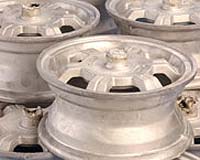
The technology, T-Mag, enables super-light magnesium alloys to be cast into high-integrity, high-strength automotive components, such as mag wheels.
by Staff Writers
Canberra, Australia (SPX) Aug 10, 2007
Casting technology developed by the Light Metals Flagship has given the Australian automotive industry a technical boost in the move to make lighter, more fuel-efficient cars. The technology, T-Mag, enables super-light magnesium alloys to be cast into high-integrity, high-strength automotive components. Low production costs make T-Mag castings cost-competitive with aluminium and steel automotive components.

"With T-Mag you can make a magnesium alloy engine block that is two-thirds the weight of an aluminium alloy engine block," CSIRO business development manager Sam Tartaglia says.

"T-Mag is designed to be simple," CSIRO casting team leader Dr Thang Nguyen says. "The result is an improved power/weight ratio and increased fuel efficiency and performance, which are much sought-after by premium car makers.

"The technology is being assessed by a group of major North American car makers. If successful, this validation will open the door to key markets. It's a fast-track entry into the market."

T-Mag is being taken to market by a partnership between CSIRO and three South Australian companies, Alloy Technologies International, SAGE Automation, and FLOTEK. The partnership has attracted a $1.95 million grant under AusIndustry's Commercial Ready Program.

T-Mag excited commercial interest when it was exhibited at GIFA, the World Foundry Congress, held in June in Dusseldorf, Germany.

"T-Mag is designed to be simple," CSIRO casting team leader Dr Thang Nguyen says.

"We've integrated melting and casting operations in a single compact unit which uses gravity rather than high pressure or vacuum to make sure the die fills smoothly from the bottom. This minimises turbulence and formation of oxides in the casting."

The result is strong, lightweight castings which do not have flow lines or internal porosity; defects which have hampered uptake of magnesium alloy castings made using existing technology.

In addition, T-Mag provides large savings in recycling and energy costs by reducing the metal needed for casting. T-Mag needs only 3.7kg of alloy to cast a 3.5kg component, compared with the 6kg to 7kg required by conventional processes.

The Light Metals Flagship's portfolio of material and process technologies focuses on transforming light metals, such as aluminium and magnesium, into products. A number of Flagship technologies are relevant to the automotive industry.

Community
Email This Article
Comment On This Article

Related Links
Car Technology at SpaceMart.com


Toyota To Delay Launch Of New Hybrids
Tokyo (AFP) Aug 09, 2007
Japan's Toyota Motor will delay by one or two years the rollout of new high-mileage hybrids with lithium-ion batteries because of safety concerns, a newspaper reported Thursday. Toyota's decision was prompted by worries that the batteries could overheat, catch fire or even explode, the Wall Street Journal reported in its online edition, quoting unnamed Toyota executives.


Memory Foam Mattress Review

Newsletters :: SpaceDaily Express :: SpaceWar Express :: TerraDaily Express :: Energy Daily
XML Feeds :: Space News :: Earth News :: War News :: Solar Energy News
  • Satellite Multimedia For Mobile Phones
  • Vizada Launches SkyFile Access For Better Mobile Satellite Data Transfer
  • Bringing Mobile Cellular Phones To The Skyways
  • Rockwell Collins And ARINC Sign Agreement For Broadband Offering

  • Russian Proton-M Rocket To Launch Japanese Telecoms Satellite
  • ILS to Launch Inmarsat Satellite On Proton Vehicle Next Spring
  • European Automated Space Truck Arrive At South American Spaceport
  • A Double Transfer At The Spaceport For The Next Two Ariane 5 Launchers

  • Boeing Flies Blended Wing Body Research Aircraft
  • Steering Aircraft Clear Of Choppy Air
  • EAA AirVenture 2007
  • Sensors May Monitor Aircraft For Defects Continuously

  • Lockheed Martin Awarded B-2 Bomber Satellite Communication System Upgrade Contract
  • Northrop Grumman Tests Airborne Networking System For Aeronautical and Land Vehicular Broadband Services
  • TSAT Teams Submit Production Proposals To US Air Force
  • LockMart And Northrop Grumman TSAT Team Announces Partnership With Juniper Networks

  • ATK To Build Satellite Link Signal Generator With Sandia National Laboratories
  • Purdue Milestone A Step Toward Advanced Sensors And Communications
  • Bridges Too Far As Infrastructure Ages Across The Old West
  • Lockheed Martin Completes Key End-To-End Test Of Space Based Infrared System

  • Northrop Grumman Appoints James Myers VP And GM Of Navigation Systems Division
  • Senior Official Of Energia Space Appointed President
  • New SIDC Commander Has The Wright Stuff
  • NASA Administrator Names Ryschkewitsch As New Chief Engineer

  • Satellite Tracking Will Help Answer Questions About Penguin Travels
  • NASA Helps Texas Respond To Most Widespread Flooding In 50 Years
  • Thailand To Launch Environment Satellite In November
  • Mapping Mountains From Space With GOCE

  • Galileo To Support Global Search And Rescue
  • Car Satellite Navigation Systems Can Be Steered The Wrong Way
  • ShoZu One-Click Image Upload Service To Be Embedded In Samsung Handsets
  • Cell Phones And PDAs Revolutionize How Consumers Find Homes On REALTOR.com

  • The content herein, unless otherwise known to be public domain, are Copyright 1995-2006 - SpaceDaily.AFP and UPI Wire Stories are copyright Agence France-Presse and United Press International. ESA PortalReports are copyright European Space Agency. All NASA sourced material is public domain. Additionalcopyrights may apply in whole or part to other bona fide parties. Advertising does not imply endorsement,agreement or approval of any opinions, statements or information provided by SpaceDaily on any Web page published or hosted by SpaceDaily. Privacy Statement