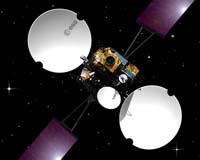
Carrying three payloads plus a number of experiments, Artemis (Advanced Relay and Technology Mission Satellite) has been developed to test and operate new telecommunications techniques. Credits: ESA - J. Huart
Carrying three payloads plus a number of experiments, Artemis (Advanced Relay and Technology Mission Satellite) has been developed to test and operate new telecommunications techniques. Credits: ESA - J. Huart |
Artemis communicates with Jules Verne, receiving telemetry and sending telecommands, each time the two spacecraft are within sight of one another. During every ATV orbit, there is around 40 minutes of continuous contact.
Artemis will provide dedicated support to Jules Verne throughout the free-flying phase of its mission - up to the docking planned for 3 April. After docking, Artemis' data relay resource will be shared between ATV and ESA's Envisat Earth observation mission.
Artemis is in geostationary orbit over the Atlantic Ocean. It has three main purposes:
+ the provision of voice and data communications between mobile terminals in remote areas of Europe and North Africa, as well as in the Atlantic
+ performing a key role within Europe's EGNOS satellite navigation system by broadcasting enhanced GPS and GLONASS signals for use by civilian 'safety critical' transport and navigational services
+ the provision of inter-orbit satellite communication using advanced S- and Ka-band radio links and laser technology
Artemis is operated from ESA's facility at Redu, which houses the spacecraft's mission control centre and a Ka-band ground terminal with a 13.5-metre dish antenna.
The task of communicating with Jules Verne is shared between Artemis and NASA's Tracking and Data Relay Satellite System (TDRSS).
The inter-orbit communications services provided by Artemis are precursors to a proposed future European satellite data relay system.
Related Links
 New Discovery At Jupiter Could Help Protect Earth-Orbit Satellites
 London, UK (SPX) Mar 10, 2008
| The content herein, unless otherwise known to be public domain, are Copyright Space.TV Corporation. AFP and UPI Wire Stories are copyright Agence France-Presse and United Press International. ESA Portal Reports are copyright European Space Agency. All NASA sourced material is public domain. Additional copyrights may apply in whole or part to other bona fide parties. Advertising does not imply endorsement, agreement or approval of any opinions, statements or information provided by Space.TV Corp on any Web page published or hosted by Space.TV Corp. Privacy Statement |